
 Slovenčina


Human life is a constant creation, exchange and death of cells. Old cells die to be replaced by new cells.
The pigment melanin is responsible for everything related to hair and skin color. There are several types of melanin and they are found in plants, animals and single-celled protozoa. They have various functions and one of them is so-called photoprotection – protection against dangerous UV radiation. This radiation has high energy and contributes to the formation of free radicals. These are atoms that cause, among other things, skin aging and various diseases. Melanin prevents the formation of free radicals by converting the energy of UV photons into heat with an efficiency of more than 99.9%.
The surface of the body comes into contact with UV radiation most, and since melanin has color, a side product of its presence is the coloring of the skin, hair and eyes. Melanin is produced by special cells called melanocytes and are found scattered in the lower layer of the skin and concentrated in the hair bulb in the lower part of the hair follicle. Melanocytes in the hair bulb are surrounded by so-called keratinocytes – cells that later form the hair fiber. It is colorless in itself and since it reflects light, it appears white. It gets color thanks to melanin, which is formed inside melanocytes and accumulates in structures called melanosomes (we can imagine them as pouches filled with melanin). These "pouches" must get from melanocytes to keratinocytes – melanocytes release them and keratinocytes then "eat" them, thus gaining color. The color of the hair fiber composed of such keratinocytes then depends on the type and amount of melanin in the melanosomes. Overall, there is not very much melanin in hair – even the darkest hair contains a maximum of 1%.
Hair color can be affected by other factors – for example malnutrition. Another factor affecting the hair color of each of us is age. Small blonde children often have their hair darken with age – scientists have not yet been able to fully explain this phenomenon. The second change associated with age is graying. Some people develop their first gray hairs as early as age 10, others have hardly any even in their fifties. Caucasians begin to gray on average at age 34, 10 years earlier than those of African descent.
Graying is caused by loss of melanin from the hair.
The life of a hair melanocyte is closely related to the life of the hair, specifically the hair follicle from which the hair grows. Hair grows usually for 2 – 3 years, exceptionally up to 7 years, before falling out. This begins a new cycle of the hair follicle, when new hair grows and new melanocytes are created to supply it with melanin. Each hair follicle has several "its own" stem cells, from which new melanocytes are created each time for new hair. But why do we constantly need new melanocytes? This is probably related to the fact that their "job" is highly risky. Melanin production is associated with the production of dangerous oxygen-containing molecules, such as hydrogen peroxide, which damage cells, in this case melanocytes. Damaged melanocytes are then no longer able to perform their function and moreover there is a risk that they could become cancer cells, so they are removed and replaced with new ones.
Approximately after 7 to 15 cycles, i.e. when the 7th to 15th hair falls out from a specific follicle, a problem arises. The next hair will start to grow, but there won't be enough melanocytes, and later, in subsequent cycles, they will form minimally or not at all. Fewer melanocytes result in less melanin and the absence of melanocytes results in the absence of melanin. Hair therefore has nothing to give it color and is therefore white – gray. New melanocytes will stop forming for a simple reason – the supply of stem cells becomes exhausted. Scientists have not yet been able to explain why this is the case. There may be several reasons, for example that stem cells have a lifespan limited by a certain number of divisions and then either differentiate or die, or that chemical signals change with age that "tell" stem cells what to do. So whoever wanted to invent a cure for graying would first have to "convince" stem cells to remain functional in the hair follicle throughout a person's life – i.e. two to three times longer than they are functional under normal circumstances.
ANTI-GRAY PRODUCTS COME TO THE RESCUE
Thanks to a formulation based on vitamins and natural substances, there is a regeneration, coloring and restoration of disappearing pigments and a gradual return of natural hair color. Leaders in innovative capillary products, PHYTEMA laboratories developed in 2001 an anti-graying mixture of plant extracts, vitamins and minerals, which effectively pigments ALL TYPES of gray and white hair by reforming keratin.
Anti-gray products are divided according to hair color
LIGHT HAIR - CLASSIC LIGHT BROWN TO BROWN DARK BROWN TO BLACK
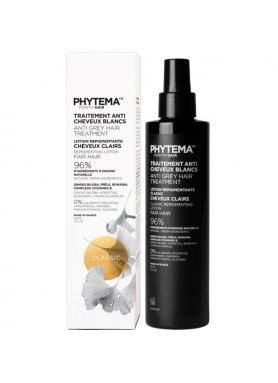
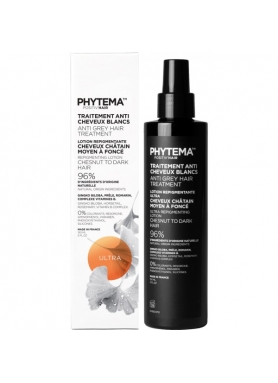
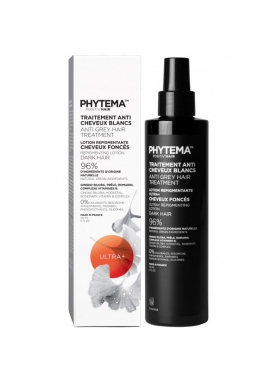
Anti-gray products contain natural active substances that are components in all types of Positiv'hair Anti-Gray mixtures:
plant extracts of watercress, horse chestnut, butcher's broom, ginkgo biloba, horsetail, rosemary, ORGANIC JOJOBA OIL*, ORGANIC SESAME OIL* and vitamins A, B5, B8, E, F and H (biotin).
*Ingredients come from controlled Organic agriculture.
|
NATURAL INGREDIENTS: |
PROPERTIES: |
|
Horse Chestnut (extract) Aesculus hippocastanum Watercress (extract) Nasturtium officinale Butcher's Broom (extract) Ruscusu aculeatus Ginkgo biloba (extract) Ginkgo biloba Horsetail (Extract) Equisetum arverse Rosemary (Extract) Rosmarinus officinalis Water Osmosis (Water) Sulfur (sulfur) Plant Alcohol (Ethanol) Plant Glycerin (glycerin) Vitamin B5 (panthenol) Vitamin B7 (Inositol) Vitamin B8 (biotin) Vitamin E (tocopherol) Vitamin F (linoleic acid) |
Improves blood circulation and venous system Prevents hair loss, helps hair regrowth Active venous tonic, protects capillaries Vasodilation, improves blood circulation Mineralization and regeneration of keratin fibers Antiseptic healing, stimulates and regenerates scalp Basic without heavy metals, nitrates, pesticides, salts Ensures keratin exchange in the hair cortex Preservative Hydrating softening properties, protects against dehydration Prevents hair loss, whitening. Hydrates Strengthens cell membrane Prevents hair loss, helps regrowth Prevents premature graying and hair loss Antioxidant. Active microcirculation |
RESEARCH AND RESULTS:
All studies were conducted on volunteers (men and women with natural hair color), according to DERMSCAN laboratory accredited by the Ministry of Health under dermatological control.
After 28 days of use:
100% of women and men demonstrate 91 percent pigmentation of gray hair. This effect is certified by self-assessment by users. The product is very popular with most women and men, especially for its natural coloring, good penetration (95%) and simple use (100%).
Instructions for use:
Very simple. Using a spray 1 application in the morning or evening on dry hair for 14 to 28 days will gradually restore your natural color. 1 application per week that will follow this series to maintain results. That's it!
Below is a comparison when using anti-gray products - day 1 - day 7 - day 14 and day 28.
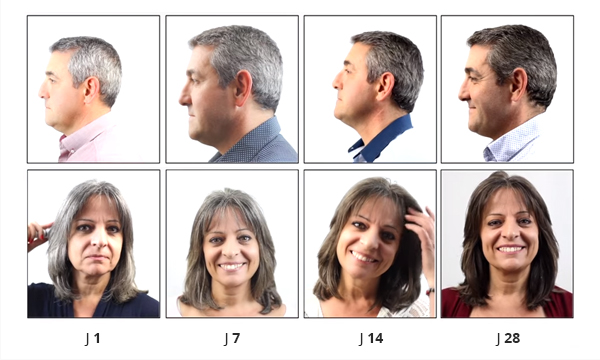
The biggest advantage of this product is that it colors hair naturally, gradually and is therefore also suitable for men.
More info about anti-graying products here.
We have had anti-gray products in our portfolio for more than 10 years and in that time we have only received positive feedback on them. Convince yourself in the reviews under the products:


